

Play Video
Ross Procedure
What is the Ross Procedure?
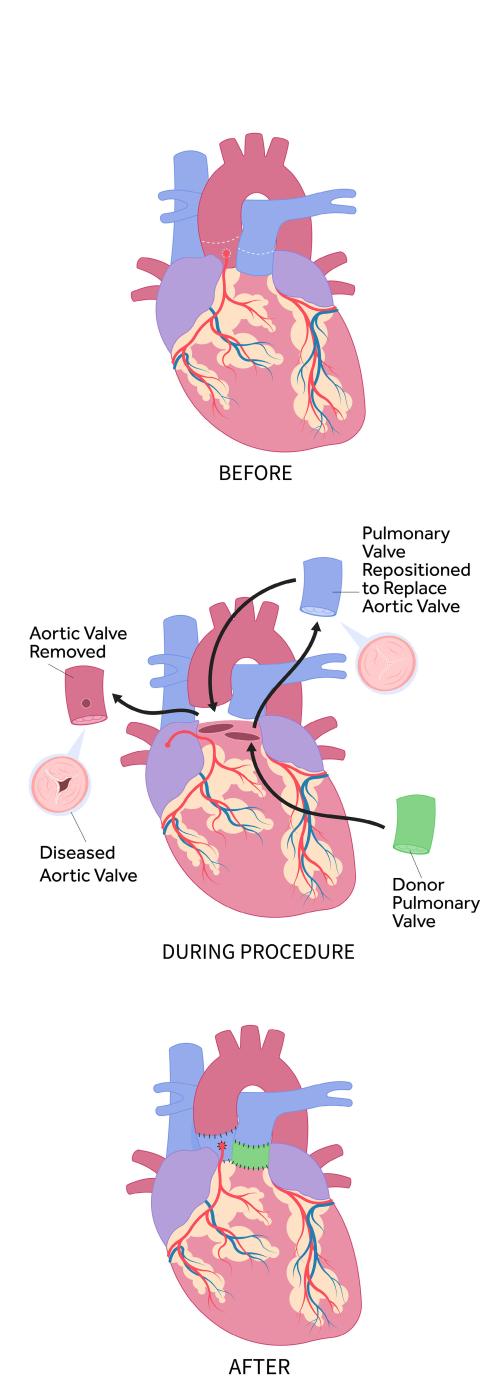
The Ross procedure is a type of heart valve surgery used to treat aortic valve disease–aortic stenosis or aortic regurgitation.
During this procedure:
1. Your diseased aortic valve is removed.
2. Your own pulmonary valve is moved into the aortic position. This is called an autograft.
3. A donor pulmonary valve, called an allograft, replaces your pulmonary valve.
As it uses your own living valve tissue in the aortic position, the Ross procedure functions more like a natural valve.
Why Consider the Ross Procedure?
For the right patient, the Ross procedure offers several potential benefits:
No Lifelong Blood Thinners: Unlike mechanical valves, most Ross patients do not require lifelong anticoagulation medication.
Excellent Long-Term Survival: Studies show survival rates comparable to the general population in young and middle-aged adults.(1-5)
Durable, Living Valve: The pulmonary autograft is living tissue that adapts and functions like a natural aortic valve.
Improved Quality of Life: Patients often return to normal activities without the restrictions associated with mechanical valves.
Strong Clinical Track Record: The Ross procedure has been performed in thousands of adult and pediatric patients worldwide.
Who May Be a Candidate?
The Ross procedure is most often considered for:
- Adults typically 50 years old or younger
- Active individuals
- Patients wishing to avoid long-term anticoagulation
- Select pediatric patients
It is not appropriate for every patient. Certain medical conditions may make the procedure unsuitable.
A detailed evaluation with an experienced heart valve team is essential.
What to Expect After Surgery
Hospital Stay
- Typically up to 1 week
- 1–2 days in ICU
- Several additional days in recovery
Early Recovery
- Full recovery may take several weeks
- Avoid heavy lifting during healing
Blood Pressure Control
For the first 6–12 months, keeping systolic blood pressure below 115 mmHg is important to protect the new valve.
Dental & Infection Prevention
- No dental procedures for 12 weeks after surgery
- Antibiotics required before future dental or surgical procedures
Are There Risks?
All heart surgery carries risks. Your surgeon will discuss your individual risk profile.
What If a Valve Needs Reoperation?
A common concern is the need for another procedure later in life.
Research shows that:
- Reintervention after a Ross procedure is not associated with worse survival. (5)
- Even if reoperation is required, normal life expectancy is maintained. (5)
Why Experience Matters
The Ross procedure is technically complex and should be performed by surgeons and centers experienced in this operation.
When meeting your surgeon, consider asking:
- How many Ross procedures have you performed?
- What are your patient outcomes?
- Am I a good candidate for this procedure?
Talk With Your Heart Valve Team
The Ross procedure can provide a durable, natural solution for select patients with aortic valve disease.
Discuss your age, lifestyle, long-term goals, and medical history with your heart team to determine whether the Ross procedure is right for you.
1. Romeo, J. L., Papageorgiou, G., Da Costa, F. F., Sievers, H. H., Bogers, A. J., El-Hamamsy, I., & Mokhles, M. M. (2021). Long-term clinical and echocardiographic outcomes in young and middle-aged adults undergoing the Ross procedure. JAMA cardiology, 6(5), 539-548.
2. Aboud, A., Charitos, E. I., Fujita, B., Stierle, U., Reil, J. C., Voth, V., ... & Ensminger, S. (2021). Long-term outcomes of patients undergoing the Ross procedure. Journal of the American College of Cardiology, 77(11), 1412-1422.
3. Mazine, A., David, T. E., Stoklosa, K., Chung, J., Lafreniere-Roula, M., & Ouzounian, M. (2022). Improved outcomes following the Ross procedure compared with bioprosthetic aortic valve replacement. Journal of the American College of Cardiology, 79(10), 993-1005.
4. Andreas, M., Wiedemann, D., Seebacher, G., Rath, C., Aref, T., Rosenhek, R., & Kocher, A. (2014). The Ross procedure offers excellent survival compared with mechanical aortic valve replacement in a real-world setting. European Journal of Cardio-Thoracic Surgery, 46(3), 409-414.
5. Ryan WH, Squiers JJ, Harrington KB, Goodenow T, Rawitscher C, Schaffer JM, DiMaio JM, Brinkman WT. Long-term outcomes of the Ross procedure in adults. Ann Cardiothorac Surg. 2021 Jul;10(4):499-508. doi: 10.21037/acs-2021-rp-fs-28.